If you’re here, it’s because you need to communicate something important: a launch, an event, a new office… and you need it to sound professional from the very first line. The good news is that a press release follows a very specific structure, and once you master it, you can adapt it to any situation in minutes.
In this guide you’ll find the structure every self-respecting press release follows, a blank template to copy and fill in, several examples depending on the goal of your announcement, and, at the end, the steps to make sure that press release doesn’t stay as a Word document, but actually reaches the media.
What is a press release and when should you use one?
A press release (or news release) is an informational text, written with a journalistic approach, that a company or organization sends to the media to announce relevant news. Unlike a blog post or a social media post, its goal is for a journalist to be able to take it, make minimal edits, and publish it as a news story.
It makes sense to write one when there’s real news behind it—this point is more important than it seems.
Press release structure (the one all the effective ones follow)
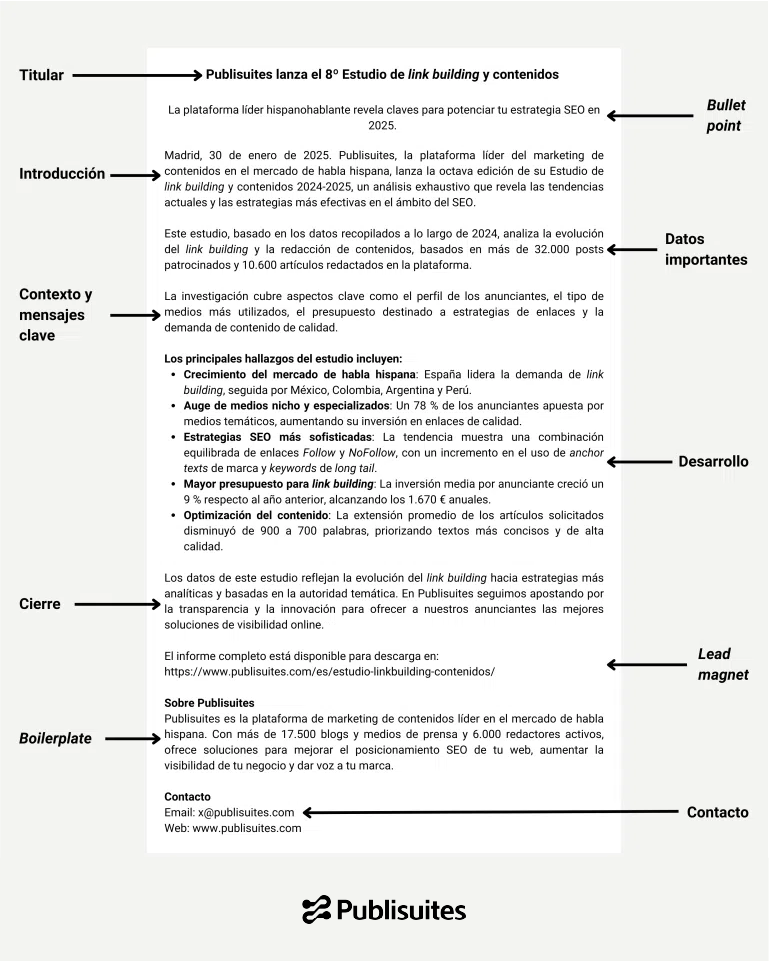
Before we move on to the examples, it’s worth being clear on the basic structure, because the models below follow it to the letter:
- Headline: Clear, informative, and understandable without having to read anything else. Avoid “creative” headlines that don’t say anything.
- Lead (opening paragraph): The first paragraph should answer what, who, when, where, and why. A journalist who only reads this part should already have the full story.
- Body: This is where you develop the information in more detail, in descending order of importance (the inverted pyramid technique): the most relevant first, secondary details after.
- Quote or statement: A quoted line from a company spokesperson adds a human angle and a citable source for the journalist.
- Background data or figures: If you have data to back up the news (growth, number of users, investment), this is where it goes.
- Boilerplate or “About”: A short, fixed paragraph describing the company, so the journalist knows who’s behind the press release even if they don’t know the brand.
- Contact details: Name, title, phone number, and email of the person a journalist can contact for more information.
Press release template to copy and customize
[HEADLINE: clear, direct announcement of the news]
[City], [date] – [Lead: what happened, who it involves, when, and why it’s relevant, in a maximum of 2–3 lines.]
[First body paragraph: expand on the context of the news, giving the most important details first.]
“[Direct quote from a company spokesperson that adds an assessment or additional context about the news],” says [Name and title of the spokesperson].
[Second paragraph: data, figures, or secondary details that reinforce the news.]
About [Company name]
[Two or three lines describing what the company does, how long it has been operating, and its value proposition.]
Press contact
[Name] – [Title]
[Phone] – [Email]
Press release examples by objective
Press release example for a product launch
[Brand name] launches [product name], a solution that [main benefit]
Madrid, [date] – [Brand name] today announced the launch of [product name], [brief description of what it is], designed for [target audience] looking for [problem it solves].
The new [product] includes [differentiating features], and will be available from [date] via [sales channel].
“With [product name], we want to meet a need we’ve seen becoming increasingly common among our customers,” explains [Name], [title] at [company].
[Additional details: price, availability, early pre-order figures, etc.]
About [company] [Company] is a company specializing in [sector], founded in [year], offering [brief value proposition].
Press contact: [name, phone, email]
Press release example for an event
[Company name] will take part in [event name] on [dates]
[City], [date] – [Company name] will be at [event name], taking place from [start date] to [end date] at [location], where it will present [what it will showcase: product, talk, booth].
During the event, [relevant detail: talk, demo, new announcement to be presented].
“It’s a unique opportunity to connect with [event audience] and show firsthand [what will be communicated],” says [Name and title].
About [company] [Brief company description].
Press contact: [name, phone, email]
Press release example for an opening or new office launch
[Company name] opens its doors in [city] with a new [m² or features] location
[City], [date] – [Company name] today inaugurated its new location in [address or city], a [m²] space that will allow the company to [reason for the opening: strengthen its presence, expand capacity, etc.].
The new location will enable [company] to [specific benefit: serve more customers, add new team members, expand services].
“This opening reflects the growth we’ve seen over the past [time period],” says [Name and title].
About [company] [Brief company description].
Press contact: [name, phone, email]
Corporate press release example (company changes)
[Company name] appoints [Name] as the new [title]
[City], [date] – [Company name] has announced the appointment of [Name] as [title], effective [date]. [Name] replaces [previous name, if applicable] and will lead [area or responsibility].
[Name] has [years] of experience in [sector/function], having previously served as [previous title] at [previous company, if relevant and public].
“We’re confident their experience will be key to [company objective at this stage],” says [Name and title of the person announcing the appointment].
About [company] [Brief company description].
Press contact: [name, phone, email]
Short press release example
[Direct headline of the news]
[City], [date] – [Company] has announced [news], with the goal of [reason]. [Additional detail in one sentence]. More information at [website or link].
Press contact: [name, phone, email]
Common mistakes when writing a press release
- Promotional headlines instead of informative ones: A journalist will dismiss in seconds a release that sounds like an ad rather than news.
- Burying the important information: If the key detail appears in the third paragraph, you’ve lost the reader (and the journalist) before they get there.
- Too long: A press release isn’t a blog post—the more direct and concise it is, the easier it is to publish as-is.
- No quote or no contact details: Without a statement and clear contact details, many outlets will dismiss it outright.
- Not tailoring the release to the outlet: Sending a release to a general-interest outlet isn’t the same as sending it to a specialized one in your industry—the angle and level of detail should vary.
How to publish your press release in real media outlets (and not let it sit in a drawer)
Writing the press release is only half the work. The other half—and the part that really makes the difference—is getting it published in outlets with a real audience, not just in directories nobody visits.
This is where Publisuites’ press release service comes in. Instead of sending your release blindly and waiting for a response, the platform lets you choose exactly which digital outlets you want to publish it in, filtering by language, country, province, SEO authority, and price, among other criteria, across a network of hundreds of verified outlets.
Here’s how it works in practice:
- You choose the outlet, with real traffic and authority data before paying for publication.
- You send your press release (or outsource the writing if you don’t have it ready yet) and the outlet publishes it following its own editorial line, which gives it greater credibility with readers.
- No need to sign a long-term contract or monthly fees: you pay per publication, and you can scale the number of outlets based on the results you see.
- You get support from a team of SEO experts who advise you on which outlets best fit your news and your industry, with proposals within 24 business hours.
This route is especially useful if your goal isn’t just to get a link, but to gain real press visibility: appearing in Google Discover and Google News, generating coverage for searches of your brand, and adding social proof (“as seen in…”) that you can reuse on your own website or social media.
Frequently asked questions about press releases
How long should a press release be? Typically, between 300 and 500 words. If you need more space to explain a complex topic, it’s better to split it into several press releases rather than making a single one too long.
Is a press release the same as a sponsored post? Not exactly. A press release is written with a journalistic approach and is usually published according to the outlet’s editorial policy, while a sponsored post typically gives you more freedom over the content and the number of links included.
How much does it cost to publish a press release in the media? The price depends on the audience and authority of the outlet you choose. On platforms like Publisuites, you can find options ranging from budget-friendly placements to high-reach outlets, and you decide where to invest based on your goal.
Are press releases good for SEO? They can help indirectly: they improve brand visibility, generate mentions and, in some outlets, links too. But their main value is still media coverage and the credibility that comes from appearing in the press.